Track component service life from installation history
A machine may always have a belt, hose, filter, or other replaceable component in the same position. The component in that position changes over time. Storing only the current part and installation date erases the history needed to understand previous service life.
The practical model records every installation period. PHPRunner can provide the maintenance forms and reports, while one database rule protects the sequence: a position can have only one active installation at a time.
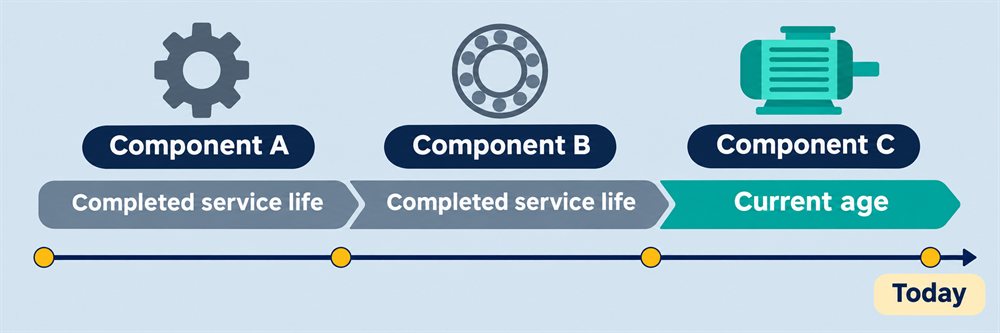
Quick answer: Replacing a component should close the previous installation and open the next one in a single transaction. Calculate completed service life from installation to removal, and current age from installation to today. Keep those two values distinct.
Model the position separately from the component
A machine has positions such as main drive belt, coolant hose, or intake filter. An installation record joins one physical or catalogued component to one position for a period of time. It records the installation date, removal date, reasons, technicians, and supporting notes or documents.
The current component is the installation with no removal date. Previous records remain closed history. This avoids repeatedly overwriting a single “last replacement” field and makes every service interval traceable.
Replace as one operation
A replacement form should identify the active installation, collect the removal details, and collect the new installation details. Saving closes the old row and inserts the new row inside one database transaction. If either action fails, neither should remain committed.
Enforce one active installation per position in the database where possible. Also detect stale forms. If two technicians open the same position and both submit a replacement, the second must see that the active installation has already changed instead of creating two current components.
Report age without implying prediction
For a removed component, completed calendar service life is the time between installation and removal. For the active component, current calendar age is the time between installation and the reporting date. Label active values as age so they are not mistaken for a completed life.
Calendar duration is not operating hours, cycles, distance, load, or condition. If those measures matter, capture them from a verified source and define their own calculation. A history of past lifetimes can support review, but it does not by itself predict failure or prescribe a replacement interval.
Protect the chronology
Reject a removal date before the installation date and prevent overlapping installation periods for the same position. Backdated corrections require extra care because they can change more than one interval. Record the reason and preserve an audit history rather than silently rewriting the sequence.
Decide how to represent temporary removal, reinstalling the same serialized component, unknown historical dates, and a position that is intentionally empty. These are business meanings, not merely blank fields.
Test the replacement workflow
- Submit two replacements for the same position at nearly the same time. Only one new installation may become active.
- Try to create a second active installation directly. The database rule should stop it.
- Enter a removal date before installation. The operation should fail with a useful explanation.
- Backdate a replacement into an existing interval. The application should detect the overlap.
- Open the machine history after several replacements. Every interval and reason should remain readable.
How PHPRunner fits
PHPRunner can build machine, position, component, replacement, attachment, and history pages from the maintenance database. Permissions can separate routine viewing from replacement and correction rights. Server-side events and transactions can make replacement one controlled operation.
The result is a descriptive maintenance history, not a failure prediction or maintenance recommendation. Safe service limits and inspection schedules must come from qualified engineering, manufacturer guidance, or the organization's approved maintenance program.